 Opals
Opals
 Gemstones
 Jewelry
 Coins
Coins


No has pujado en esta subasta.
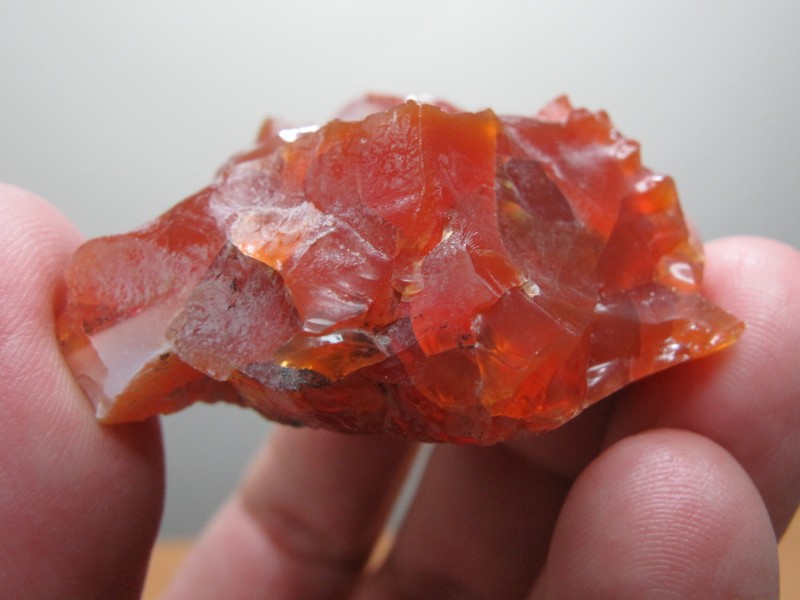
21.20 ct Fire Opal Cantera Specimen from Honduras
- SKU
- Dimensiones (mm)
- 26.5 x 16 x 13mm
- Peso (cts)
- 21.2
- Type
- Rough
- Colores
-
-This is a fire opal cantera specimen from a new finding in Honduras.
-For COLLECTORS and CUTTERS.
-Untreated.
-The pictures are taken under a two jewelers lamp when stones are WET (recently dried up). There is a slight difference in colors when stones are dry and when stones are wet. Colors have a range from brownish orange to brownish red.
-I checked the refractive index of a polished stone and it is 1.44 to 1.45.
-Although this finding is new, fire opals in Honduras were reported many years ago by early explorers.
-In his book ‘The World of Opals’ (1997), Allan W. Eckert writes: “San Antonio area mines are most productive of a very light-colored precious fire opal that most resembles the Mexican variety (...). Other opals of this type occur at a number of locations throughout the country (...). The stones here, mainly found loose on the ground surface, have a colorless transparent center which turns to transparent citrine yellow and, finally, near the outside edges to a transparent light brownish-orange. The majority is used for faceting purposes”.
-And Tom R. Barbour, C.G. wrote in The Lapidary Journal (April 1965): “Produced by hand and as yet on a small scale, there is in Honduras opal of almost every description including all of that found in Australia (...). Because of the very difficult mountainous country with little or no roads, Honduras has not been developed. However, with the promise of roads in this country in the comparatively near future, we hope it will turn into one of the main gem and opal producing areas of the world (...). In the first group we will include common opal or, in other words, that which does not display colors when viewed in reflected light. The ‘Mexican fire opal’ type is found in several places throughout Honduras (...). This opal is found in weathered veins of from one-fourth of an inch up to six inches in width. The outside, next to the matrix, is a light orange brown turning to lighter shades then to a citrine color with a clear center. Most of this type (...) is fractured into pieces from one-half inch to about two inches of clear faceting material”.
| Proveedor de envío | Envío a Panamá | Envíos al resto del mundo | Envío combinado ( Panamá ) | Envío combinado (resto del mundo) |
|---|---|---|---|---|
| Standard Shipping - Tracked |
|
|
|
|
| Express Shipping |
|
|
No disponible |
|
- SKU
- Dimensiones (mm)
- 26.5 x 16 x 13 mm
- Peso (cts)
- 21.2
- Type
- Rough
- Colores
-
-This is a fire opal cantera specimen from a new finding in Honduras.
-For COLLECTORS and CUTTERS.
-Untreated.
-The pictures are taken under a two jewelers lamp when stones are WET (recently dried up). There is a slight difference in colors when stones are dry and when stones are wet. Colors have a range from brownish orange to brownish red.
-I checked the refractive index of a polished stone and it is 1.44 to 1.45.
-Although this finding is new, fire opals in Honduras were reported many years ago by early explorers.
-In his book ‘The World of Opals’ (1997), Allan W. Eckert writes: “San Antonio area mines are most productive of a very light-colored precious fire opal that most resembles the Mexican variety (...). Other opals of this type occur at a number of locations throughout the country (...). The stones here, mainly found loose on the ground surface, have a colorless transparent center which turns to transparent citrine yellow and, finally, near the outside edges to a transparent light brownish-orange. The majority is used for faceting purposes”.
-And Tom R. Barbour, C.G. wrote in The Lapidary Journal (April 1965): “Produced by hand and as yet on a small scale, there is in Honduras opal of almost every description including all of that found in Australia (...). Because of the very difficult mountainous country with little or no roads, Honduras has not been developed. However, with the promise of roads in this country in the comparatively near future, we hope it will turn into one of the main gem and opal producing areas of the world (...). In the first group we will include common opal or, in other words, that which does not display colors when viewed in reflected light. The ‘Mexican fire opal’ type is found in several places throughout Honduras (...). This opal is found in weathered veins of from one-fourth of an inch up to six inches in width. The outside, next to the matrix, is a light orange brown turning to lighter shades then to a citrine color with a clear center. Most of this type (...) is fractured into pieces from one-half inch to about two inches of clear faceting material”.
| Proveedor de envío | Envío a Panamá | Envíos al resto del mundo | Envío combinado ( Panamá ) | Envío combinado (resto del mundo) |
|---|---|---|---|---|
| Standard Shipping - Tracked |
|
|
|
|
| Express Shipping |
|
|
No disponible |
|
-
 Positivo
Paid and shipped - no feedback left after 100 days

-
Positivo
A real beauty, give me more plz.


-
Positivo
Thank you for the interesting item!

-
Positivo
Thank you for the interesting item!

-
Positivo
Thank you for the interesting item!

-
Positivo

¿Por qué los usuarios se superan a sí mismos?
Cuando se realiza una oferta, este es el monto máximo que una persona está dispuesta a ofertar por el producto. Nuestro sistema ofertará automáticamente en nombre del postor y aumentará la oferta de manera gradual hasta el máximo para mantener su posición como el mejor postor.
Cuando hay un ícono que indica "Oferta automática", significa que nuestro sistema está realizando ofertas de forma activa para el postor en función de su oferta máxima. Esto puede parecer como si los postores estuvieran pujando más que ellos mismos, pero es simplemente el resultado de que el sistema actualiza la oferta para reflejar el límite máximo del postor.
